
Comparing Leasing vs Buying in 2026: Which Is Right for You?


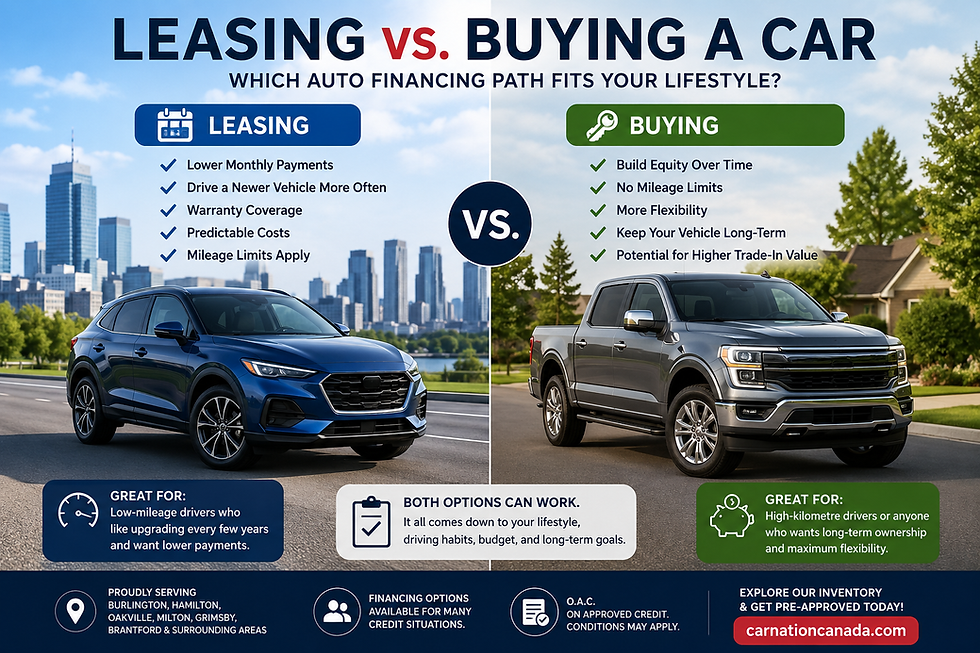
Leasing vs buying in 2026 comes down to more than the monthly payment—your kilometres driven, long-term plans, budget, credit profile and desire for ownership all matter.
Choosing your next vehicle is exciting. Deciding how to pay for it can be more complicated. Should you lease a new SUV for a few years, or finance a car, truck or minivan and work toward owning it outright?
For drivers in Burlington, Hamilton, Oakville and communities across Southern Ontario, there is no single answer that works for everyone. A payment-focused commuter may have different priorities from a growing family, a newcomer establishing credit, or someone planning to keep their next vehicle for eight or ten years.
At Car Nation Canada, we believe the better question is not simply, “Which payment is lower?” It is: “Which option makes the most sense for your budget and how you actually use your vehicle?”
Key Takeaways
Leasing can offer lower payments over a comparable term, but you generally do not own the vehicle when the lease ends unless you exercise a purchase option.
Buying or financing builds toward ownership and gives you more freedom around kilometres, vehicle modifications and when you sell or trade.
Lease agreements can include kilometre limits, wear-and-tear requirements and potentially costly early termination terms.
A lower monthly finance payment does not automatically mean a lower total cost. Longer loan terms can increase the amount of interest paid over the life of the loan.
Your decision should consider your term length, annual driving, trade-in plans, cash flow and total cost, not payment alone.
Current lease programs and incentives can change by model and month, so review Car Nation Canada’s current vehicle offers and confirm the terms that apply to the vehicle you are considering.
What Does Leasing a Vehicle Mean in 2026?
A vehicle lease is essentially an agreement to use a vehicle for a defined period while making regular payments.
According to the Financial Consumer Agency of Canada’s explanation of vehicle financing options, leases commonly run for approximately three to five years. At the end of the term, you generally return the vehicle, although some agreements give you the option of purchasing it.
Because you are not financing the vehicle in the same way as a traditional purchase, lease payments can be lower than financing payments over a comparable period. However, the agreement may also contain restrictions involving kilometres travelled, vehicle condition and early termination.
That distinction matters for anyone commuting regularly between communities such as Milton and the surrounding GTHA.
Before signing, estimate your real annual kilometres, not your ideal annual kilometres. A long commute, weekend travel, cottage trips or using your SUV or truck for work can add kilometres faster than expected.
What Does Buying or Financing a Vehicle Mean?
When you finance a vehicle, you borrow money toward its purchase and repay that amount according to the terms of your loan.
Once the balance is fully repaid, you own the vehicle outright.
That creates one of the biggest differences in the leasing vs buying in 2026 debate: financing is structured toward ownership, while leasing primarily pays for the right to use the vehicle during the contract period.
Buying can make particular sense if you:
Want to keep the vehicle for many years
Drive a high or unpredictable number of kilometres
Want the freedom to customize your truck, SUV or car
Want to sell or trade the vehicle when it suits you
Like the idea of eventually having no monthly vehicle loan payment
Financing terms still deserve careful attention. The Financial Consumer Agency of Canada recommends comparing the interest rate, payment schedule, financing fees, total amount financed and loan length rather than judging an offer by the monthly payment alone.
You can explore Car Nation Canada’s new and used vehicle inventory while comparing vehicles at different price points. The network currently provides access to new and pre-owned cars, trucks, SUVs and minivans.
Leasing vs Buying in 2026: Comparing the Financial Pros and Cons
Leasing: Potential Advantages
Lower payments over a comparable term
One of leasing's biggest attractions is cash flow. The Financial Consumer Agency of Canada notes that lease payments are generally lower than payments on a car loan with the same term.
That may appeal to a household trying to fit transportation into a defined monthly budget.
A newer vehicle more often
If you enjoy switching into a newer sedan, SUV or truck every few years, leasing provides a natural replacement cycle without first having to sell your existing vehicle.
Possible warranty alignment
Depending on the vehicle and lease agreement, much of your lease period may overlap with the manufacturer's warranty. Always confirm the specific warranty coverage rather than assuming every repair will be included.
Several end-of-term possibilities
Depending on your contract, you may be able to return the vehicle, replace it with another vehicle or purchase it at the agreed end-of-term amount.
Leasing: Potential Disadvantages
You generally do not build ownership
After several years of payments, returning the leased vehicle normally means you leave without owning it.
For drivers thinking long term, that can be an important financial consideration.
Kilometre restrictions can matter
Lease agreements may establish a kilometre allowance. Going over the contracted amount can result in additional charges, depending on the agreement.
A driver regularly travelling throughout the Niagara corridor or into Grimsby should pay particularly close attention to expected annual driving.
Wear-and-tear requirements
Excessive damage or wear may lead to end-of-lease charges.
Ending a lease early can be expensive
The FCAC specifically warns that breaking a lease before the end of its term may be very costly.
That makes leasing potentially less attractive if your employment, family size or driving requirements could change substantially during the lease.
Buying: Potential Advantages
You Are Working Toward an Asset
Once your loan is paid, the vehicle belongs to you.
It will have depreciated, but it may still hold meaningful resale or trade-in value. That value can potentially be used toward your next vehicle.
No Contractual Kilometre Limit
If your annual driving changes dramatically, ownership offers more flexibility.
This can be particularly valuable for commuters, travelling sales professionals, tradespeople and families regularly driving between areas such as Brantford and the western GTHA.
More Control Over When You Replace the Vehicle
You can generally keep, sell or trade your vehicle according to your own plans rather than a lease-end date.
You Can Eventually Eliminate the Loan Payment
Drivers who buy a reliable vehicle and keep it for years after the loan is repaid may enjoy a period without a monthly vehicle finance payment, although maintenance, insurance, fuel and other ownership expenses continue.
Buying: Potential Disadvantages
Payments May Be Higher
Compared with leasing over a similar term, financing can involve a higher monthly payment because you are working toward ownership of the vehicle.
Depreciation Becomes Your Concern
Vehicles generally lose value over time. If the outstanding loan balance is greater than the vehicle's market or trade-in value, you may have negative equity.
The Financial Consumer Agency of Canada specifically recommends understanding depreciation and negative equity when financing a vehicle.
If you already have a vehicle to trade, discussing its estimated value before choosing your next loan can help you understand the complete financial picture.
Longer Terms Can Increase Total Interest
Stretching a loan over more years may reduce the regular payment, but it can also increase total borrowing costs. FCAC examples demonstrate that extending the loan term can materially increase the overall amount paid.
That is why we encourage shoppers to ask about both the payment and the total cost of borrowing.
Why Interest Rates Still Matter in 2026
The financing environment is another factor in the lease-versus-buy calculation.
On July 15, 2026, the Bank of Canada maintained its target overnight rate at 2.25%. Vehicle finance and lease rates are not the same as the Bank of Canada policy rate; lenders determine their own offers based on multiple factors. Still, the broader interest-rate environment influences the cost of borrowing throughout the economy.
That makes comparison especially important.
When reviewing an offer, consider:
Vehicle selling price
Down payment
Trade-in value
Interest or lease rate
Term length
Regular payment
Applicable fees
Lease kilometre allowance
End-of-lease obligations
Purchase option, if applicable
Total cost over the period you expect to drive the vehicle
For additional household budgeting and money-management reading, you can also visit the Globe and Mail personal finance section.
Should a Budget-Focused Family Lease or Buy?
Suppose your household needs a larger SUV or minivan, but rising food, housing, insurance and other expenses have made monthly cash flow especially important.
A lease may deserve consideration if a lower short-term payment is the priority and your driving fits comfortably within the agreement.
Buying may make more sense if you plan to keep the family vehicle for many years and want to build toward ownership.
Neither answer should be based on payment alone.
Our team can help you compare vehicle financing options against available inventory so you can see what fits your actual household budget.
Financing options are available for many credit situations. O.A.C. — On Approved Credit. Conditions may apply.
What About Newcomers or Drivers Rebuilding Credit?
If you are a newcomer to Canada, have a limited Canadian credit history or have experienced previous credit challenges, eligibility can affect which options are available.
Rather than assuming that leasing or buying will automatically be better, start by determining:
What payment comfortably fits your budget?
How much do you realistically drive?
How long do you expect to keep the vehicle?
Do you have a trade-in?
Is there negative equity on your current vehicle?
Which financing or leasing programs are available based on your application?
You can begin with Car Nation Canada's finance application and pre-approval resources and then compare qualifying options against the current vehicle inventory.
Approval, rates, terms and available programs depend on the applicant and lender. O.A.C. — On Approved Credit. Conditions may apply.
So, Is Leasing or Buying Better in 2026?
There is no universal winner.
Leasing may be right for you if you value a potentially lower payment over a comparable term, enjoy driving newer vehicles, have predictable annual kilometres and are comfortable returning the vehicle rather than automatically owning it.
Buying may be right for you if long-term ownership matters, you drive substantial kilometres, want more control over the vehicle and intend to keep it beyond the financing period.
For many shoppers, the smartest decision is to compare both using the same assumptions: same vehicle class, realistic annual kilometres, similar time horizon and total dollars spent, not just the advertised payment.
Conclusion
When comparing leasing vs buying in 2026, think beyond what leaves your bank account every month.
Consider how many kilometres you drive, how long you expect to keep your vehicle, whether ownership is important, how your trade-in affects the numbers and what each option costs over your realistic ownership period.
Drivers throughout Southern Ontario can browse Car Nation Canada's current inventory and then speak with our finance team about the options available for the vehicle and budget they have in mind.
The goal is not to push you toward a lease or a loan. It is to help you understand the numbers well enough to choose confidently.
O.A.C. — On Approved Credit. Conditions may apply.
FAQ: Leasing vs Buying in 2026
Is leasing cheaper than buying a car?
Not automatically. Leasing can provide lower payments than financing over a comparable term, but you normally do not own the vehicle at the end unless you purchase it. Repeated leasing may also cost more overall than buying and keeping a vehicle long term.
Is buying better if I drive a lot?
It often deserves stronger consideration. Financing does not normally impose the contractual kilometre limits associated with leases, making ownership attractive for high-kilometre commuters or drivers with unpredictable travel.
Can I buy my leased vehicle at the end?
Some lease agreements provide an end-of-term purchase option. Review the contract carefully to understand whether that option exists and what amount would be payable.
Should I choose the option with the lowest monthly payment?
Not without comparing the total cost. The FCAC recommends evaluating the interest rate, fees, amount financed and loan term because stretching repayment over a longer period can reduce payments while increasing total interest.
Can Car Nation Canada help if my credit is less than perfect?
Car Nation Canada offers financing resources for customers in a range of circumstances. You can review financing and pre-approval options here. Approval and terms depend on the applicant and lender. Financing options are available for many credit situations. O.A.C. — On Approved Credit. Conditions may apply.
--------------------------------------------------------------------------------------------------------------------------
With over four decades in the automotive industry, Dealer Principal Rick Paletta is a trusted name across the Hamilton–Burlington region. Born and raised locally, Rick is respected for his integrity, work ethic, and people-first leadership—and he still loves this business because it’s about helping neighbours, building relationships, and matching people with vehicles they’re excited to drive. His commitment to the community shows up in consistent giving, including long-running support of McMaster Children’s Hospital through Car Nation Cares.


Comments