
Leasing vs. Buying a Car in Canada: Spilling the Tea on Which Is Better


Leasing vs. buying a car in Canada comes down to more than the monthly payment—compare total cost, kilometre limits, ownership, flexibility, financing terms, and your long-term driving plans before deciding.
Confused about whether to sign a lease or commit to buying? You’re definitely not alone. Leasing vs. buying a car in Canada can look surprisingly similar when you focus on the payment, but the financial outcome can be very different.
For drivers in Burlington, Hamilton, Oakville, Milton, and throughout Southern Ontario, the better choice depends on how much you drive, how long you keep vehicles, your budget, and whether ownership matters to you.
The goal isn't simply to find the lowest payment. As the Financial Consumer Agency of Canada recommends, shoppers should consider the total cost of a vehicle—not only the payment or advertised interest rate.
Key Takeaways
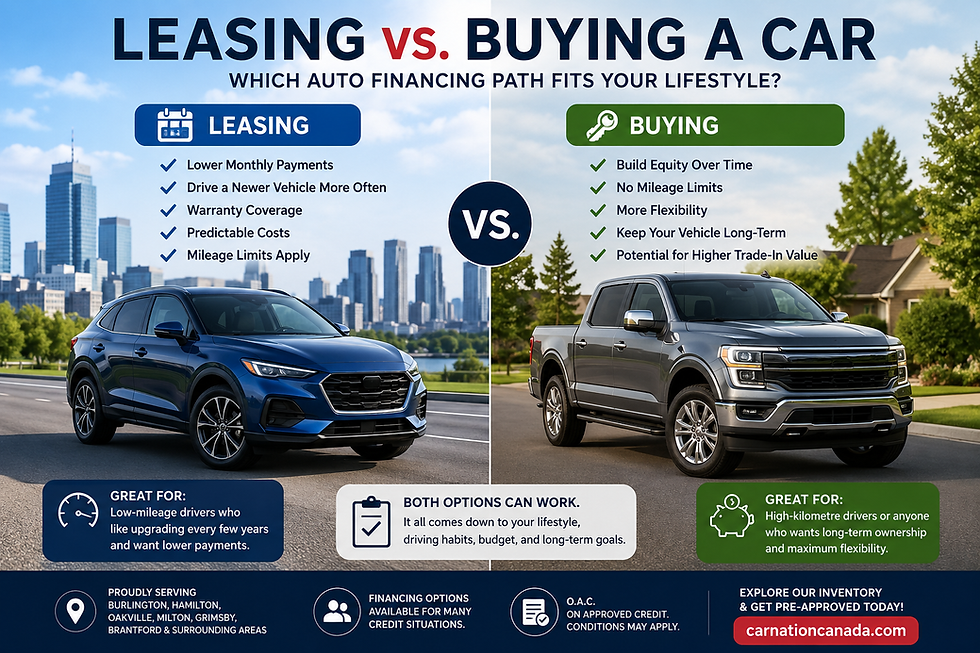
Leasing may offer a lower monthly payment than financing the same vehicle over the same period, but you generally don't own the vehicle at the end.
Buying builds ownership as you pay down the loan and can eventually leave you with a vehicle and no monthly loan payment.
Leases typically come with kilometre allowances, vehicle-condition requirements, and potential excess-use charges.
A lower monthly payment does not automatically mean a lower total cost.
Long finance terms can make payments easier to manage but may increase total interest costs and the risk of negative equity.
Your budget, expected kilometres, trade-in position, lifestyle, and future plans should all be part of the decision.
Financing and lease approvals are subject to lender requirements. O.A.C. — On Approved Credit. Conditions may apply.
Leasing vs. Buying a Car in Canada: What's Actually Different?
Here's the simplest way to think about it.
When you finance a vehicle, you're borrowing money to purchase it. Once the loan is paid off, the vehicle belongs to you.
When you lease a vehicle, you're essentially paying for the use of that vehicle during an agreed period. According to the Financial Consumer Agency of Canada, vehicle leases are typically structured for about three to five years. At the end, depending on the agreement, you may return the vehicle, lease something else, or have an opportunity to purchase it.
Consideration | Leasing | Buying/Financing |
Monthly payment | Often lower for a comparable term | Often higher for a comparable term |
Ownership | Usually no ownership at lease end | You own it once financing is paid |
Kilometres | Contract limits usually apply | Drive as much as you want |
Wear and tear | Excess charges may apply | Your vehicle, your decision |
Customization | Usually restricted | More freedom |
Changing vehicles | Convenient every few years | Requires selling or trading |
Long-term payment-free driving | Usually not | Possible after loan payoff |
Equity | Generally none unless a buyout makes sense | Vehicle may have trade-in/resale value |
Neither column automatically wins. Your driving habits decide which benefits actually matter.
The Tea on Leasing: Why People Love It
Leasing can be attractive if you enjoy driving newer vehicles and don't necessarily want to keep the same SUV, sedan, truck, or minivan for eight or ten years.
Lower Payments Can Be Appealing
The FCAC notes that lease payments are generally lower than payments on a car loan for the same term.
That can matter to a payment-focused household trying to keep monthly obligations manageable.
But here's the important part: payment and cost aren't the same thing.
A smaller monthly number may look easier on your budget today, while repeatedly leasing vehicles over many years can mean continuously having a vehicle payment. Ontario's motor vehicle regulator, OMVIC, similarly points out that frequently replacing a vehicle can cost more over the long run than keeping a paid-off vehicle.
You Can Change Vehicles More Often
Maybe you're driving a compact sedan today but expect to need a three-row SUV after your family grows.
Or perhaps you like upgrading technology, safety features, infotainment, and fuel-efficiency improvements every few years.
Leasing can make those transitions relatively straightforward because you aren't responsible for selling an older vehicle every time you're ready to change.
Warranty Coverage May Line Up With Your Lease
Because leased vehicles are commonly newer, the lease period may overlap with manufacturer warranty coverage.
That doesn't mean every maintenance or repair expense disappears, so always review the specific warranty and lease agreement.
The Catch With Leasing: Kilometres Matter
This is one of the biggest considerations for Southern Ontario commuters.
A lease normally specifies how many kilometres you can drive. Go beyond that allowance, and additional charges may apply when you return the vehicle. OMVIC recommends understanding those kilometre limits before signing and notes that additional kilometres can sometimes be negotiated upfront.
Imagine commuting regularly between Grimsby and Burlington, Hamilton and Mississauga, or Brantford and the western GTA.
Those kilometres can add up quickly.
If your job involves significant driving, you regularly visit family outside the region, or weekend road trips are part of your lifestyle, estimate your annual kilometres before deciding that a lease payment looks attractive.
Wear and Tear Can Also Cost You
A leased vehicle has to be returned according to the conditions in your agreement.
Excessive scratches, dents, interior damage, tyre wear, neglected maintenance, or other damage beyond acceptable standards may result in additional charges.
If your vehicle is going to spend weekends hauling sports equipment, carrying young kids, transporting pets, or visiting muddy construction sites, buying may offer more freedom.
Buying a Car: The Case for Ownership
Buying usually makes the most sense for people who want to keep their vehicle for the long haul.
You'll make payments while the loan is outstanding, but once the loan is paid off, that payment ends.
And the vehicle is yours.
That creates an opportunity that leasing usually doesn't: several years of driving without a loan or lease payment, assuming you keep the vehicle.
You Control Your Kilometres
Driving 15,000 km this year and 30,000 km next year?
When you own the vehicle, there's no lease kilometre penalty to worry about.
High-kilometre commuters, travelling salespeople, families with multiple activities, and drivers covering the Niagara-to-GTA corridor may especially appreciate that flexibility.
Your Vehicle Can Become a Trade-In
Ownership can also give you equity.
If your vehicle is worth more than the amount remaining on the loan, that difference may help when you eventually trade it toward your next vehicle.
You can explore current new and used vehicle inventory and compare SUVs, trucks, sedans, minivans, and other options at different budget levels before deciding how much vehicle fits your plan.
But Buying Has Its Own Financial Traps
Financing isn't automatically the financially superior choice.
One of the biggest risks is focusing on payment alone.
Suppose extending a loan term dramatically reduces the monthly payment. That sounds helpful—but you're also borrowing for longer.
The FCAC warns that auto loans of 72 months or longer can increase the total interest paid and may leave borrowers in negative equity for longer. Negative equity means owing more on the loan than the vehicle is currently worth.
That's especially important if you expect to trade again relatively soon.
Rolling negative equity into another vehicle can increase the size of the next loan and potentially increase the interest you'll pay.
Before signing, ask about:
Vehicle selling price
Down payment or trade-in credit
Trade-in loan balance
Interest rate
Length of the finance term
Total cost of borrowing
Total amount paid over the agreement
Whether any negative equity is being included
Optional products or protections
The monthly payment matters—but it should never be the only number you review.
Leasing vs. Buying When Credit Is Part of the Conversation
Your credit profile can also influence which paths are available.
Someone rebuilding after a consumer proposal, a newcomer to Canada establishing a credit file, or a household recovering from a financially difficult period may have different options from a borrower with a long-established prime credit history.
That's okay. The useful question is: What structure fits your current budget without creating unnecessary pressure?
Our team can help you explore vehicle financing and pre-approval options for many credit situations and discuss available vehicles at payment levels that make sense for your budget.
Approval, rates, terms, down-payment requirements, and available vehicles depend on the applicant and lender. O.A.C. — On Approved Credit. Conditions may apply.
Should You Lease or Buy? Try This Quick Test
Leasing may make more sense if you:
Prefer a newer vehicle every few years
Drive predictable annual kilometres
Take good care of your vehicles
Don't care about eventually owning the vehicle
Value potentially lower payments during the lease term
Are comfortable staying within the lease agreement
Buying may make more sense if you:
Want to keep your vehicle for many years
Drive a lot of kilometres
Want freedom from lease-end condition requirements
Want eventual ownership
Hope to drive payment-free after the loan is finished
Want potential trade-in or resale value later
For many budget-focused families, buying a reliable vehicle and keeping it after the loan is repaid can be attractive.
For someone who prioritizes newer technology, predictable driving habits, and changing vehicles regularly, leasing can have real advantages.
Leasing vs. Buying: Look at Total Cost, Not Just the Flex
A shiny new vehicle and a tempting monthly payment can make almost any deal look good at first glance.
But your best financial move is the one that still makes sense after you've considered the whole picture.
The FCAC recommends comparing total vehicle costs, including interest, insurance, fuel, maintenance, and other ownership expenses—not simply choosing based on the payment.
Before committing, ask yourself:
How long will I realistically keep this vehicle?
How many kilometres do I drive each year?
Do I care about owning it eventually?
Could my family or commute change?
What will I pay in total?
Those questions will tell you much more than asking which option has the smallest biweekly payment.
Conclusion: So, Is Leasing or Buying Better?
There's no universal winner in the leasing vs. buying a car in Canada debate.
Leasing can deliver flexibility, newer vehicles, and potentially lower payments for drivers who stay within their kilometre and vehicle-condition requirements.
Buying gives you ownership, unrestricted kilometres, potential trade-in value, and the possibility of eventually driving without a vehicle payment.
Before deciding, compare the vehicle, term, total cost, your trade-in situation, and your real monthly budget.
If you're shopping around Burlington, Hamilton, Halton, Oakville, Milton, Grimsby, Brantford, or nearby communities, start by browsing our current inventory. Once you've found a few vehicles that fit your needs, our team can help you explore financing and pre-approval options and compare what works for your budget.
Financing options are available for many credit situations. O.A.C. — On Approved Credit. Conditions may apply.
FAQ
Is leasing cheaper than buying a car in Canada?
Not necessarily. A lease may have a lower payment than financing the same vehicle over a comparable term, but you normally won't own the vehicle when the lease ends. Compare the total cost of both options rather than the payment alone.
Is leasing good if I drive a lot?
It may be less suitable for high-kilometre drivers because lease agreements normally specify kilometre limits, and excess-kilometre charges may apply. Check the allowance and excess-kilometre cost before signing.
What happens after I finish paying off a financed car?
Once the loan is fully repaid and all obligations are satisfied, you own the vehicle without further loan payments. You can keep it, sell it, or use its value toward a future trade.
Can I finance a vehicle if my credit isn't perfect?
Financing options are available for many credit situations, but approvals and terms depend on the lender, income, credit profile, vehicle, down payment, and other factors. You can start with our finance application and pre-approval resources. O.A.C. Conditions may apply.
Should I consider my trade-in before deciding?
Yes. Find out what your current vehicle may be worth and how much, if anything, you still owe. If the loan balance exceeds the vehicle's value, you have negative equity, which can affect the cost of your next purchase.
--------------------------------------------------------------------------------------------------------------------------
With over four decades in the automotive industry, Dealer Principal Rick Paletta is a trusted name across the Hamilton–Burlington region. Born and raised locally, Rick is respected for his integrity, work ethic, and people-first leadership—and he still loves this business because it’s about helping neighbours, building relationships, and matching people with vehicles they’re excited to drive. His commitment to the community shows up in consistent giving, including long-running support of McMaster Children’s Hospital through Car Nation Cares.


Comments