
Leasing vs. Buying a Car in Ontario: Which Auto Financing Path Fits Your Lifestyle?

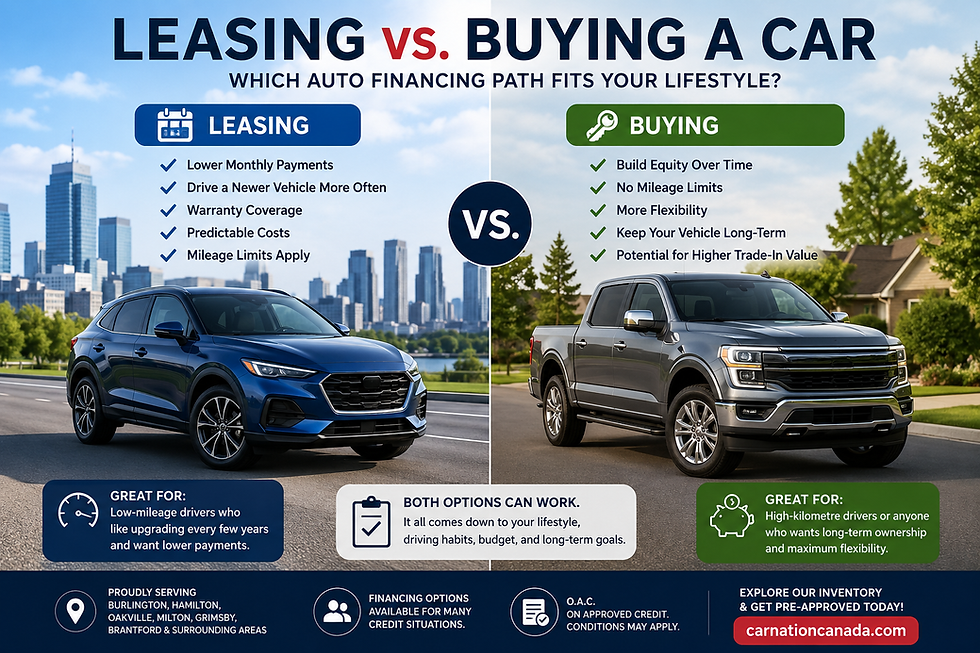
Leasing vs. buying a car in Ontario comes down to how much you drive, how long you want to keep your vehicle, your monthly budget, and whether long-term ownership or shorter-term flexibility matters more.
Choosing between leasing and buying isn't simply a question of which option has the lowest monthly payment. The better question is: Which financing path fits the way you actually use your vehicle?
For a low-mileage professional travelling between Burlington and Oakville, leasing may offer an appealing way to drive a newer vehicle every few years. For a family putting substantial kilometres on an SUV or minivan between Hamilton, Milton and the rest of the GTHA, financing a purchase and keeping the vehicle after the loan is paid could make more sense.
Self-employed professionals also have another consideration: eligible vehicle expenses used to earn business income may receive different tax treatment depending on whether the vehicle is leased or purchased. That makes it important to compare total cost, business use and long-term plans—not just the payment.
Key Takeaways
Leasing can suit drivers who travel relatively few kilometres, enjoy replacing their vehicle every few years and are comfortable staying within lease conditions.
Buying gives you ownership and the opportunity to build positive vehicle equity as the loan balance falls, although depreciation means equity is never guaranteed.
Financing may be better suited to high-kilometre drivers who want to keep a vehicle for many years.
A lower monthly payment does not automatically mean a lower total cost; compare the full lease or finance obligation before deciding.
Self-employed Canadians may be able to deduct eligible business-use vehicle expenses, but CRA limits and business-use percentages apply.
For 2026, federal automobile tax rules include specific limits for deductible passenger-vehicle leasing costs, financing interest and capital cost allowance.
Financing approval, rates, terms and payments are O.A.C. (On Approved Credit. Conditions may apply.)
Leasing vs. Buying a Car in Ontario: What's the Basic Difference?
When you finance a vehicle purchase, you're borrowing money to buy it. As you make your payments, your loan balance decreases. Once the financing obligation is satisfied, you own the vehicle outright.
A lease works differently. The Financial Consumer Agency of Canada describes vehicle leasing as a form of longer-term rental. You make regular payments to use the vehicle for an agreed period—commonly several years—but you typically don't own it when the lease ends unless the contract provides a purchase option and you choose to exercise it.
That distinction shapes almost every other part of the decision.
When a Low-Mileage Lease Can Make Sense
Leasing can be particularly attractive to drivers whose annual kilometre use is predictable and relatively modest.
Imagine that you work from home most days in Burlington, visit clients occasionally in Hamilton or Grimsby, and don't regularly make long highway commutes. A lease with an appropriate kilometre allowance may align well with that lifestyle.
Potential benefits can include:
Potentially lower payments over a comparable term. Lease payments can be lower than loan payments on the same vehicle and term because you're generally paying for the use of the vehicle rather than financing its entire purchase price. The federal government identifies this as one possible advantage of leasing.
A newer vehicle more often. Drivers who enjoy moving into newer technology, safety features or comfort features every few years may value the shorter ownership cycle.
Predictable replacement timing. At the end of the lease, you may be able to return the vehicle, purchase it according to the agreement or move into another vehicle.
Potential warranty alignment. Depending on the vehicle and lease term, much of your lease period may overlap with manufacturer warranty coverage.
A lease can therefore be appealing for professionals, downsizers or households with a second vehicle that doesn't accumulate many kilometres.
The Kilometre Limit Matters
A low-kilometre lease only works well if the agreed allowance realistically reflects your driving habits.
Lease agreements commonly include kilometre restrictions, and exceeding the allowance may lead to additional charges. Federal consumer guidance also notes that there is generally no financial credit simply because you return a leased vehicle substantially under its permitted kilometres.
Before leasing, estimate your real driving rather than your ideal driving.
Include:
commuting
school and daycare trips
client visits
weekend travel
cottage trips
hockey tournaments
cross-border or longer-distance vacations
A driver who expects their lifestyle to change during the lease should leave some breathing room.
The Potential Downsides of Leasing
Leasing provides flexibility in some areas but restrictions in others.
You don't automatically own the vehicle at the end of the term, so years of payments don't necessarily result in an asset sitting in your driveway. Ending a lease early can also be expensive, and lease agreements may impose charges related to excess kilometres or excessive wear and tear.
That can make leasing less attractive if you're likely to:
drive substantially more than your kilometre allowance
customize your truck or SUV
keep the same vehicle for eight, ten or more years
experience a major lifestyle change during the lease
want complete freedom over when to sell or trade your vehicle
If your daily routine includes frequent travel between Brantford, Hamilton, Burlington and the GTA, buying may deserve a closer look simply because high annual kilometre use can reduce the advantages of a low-mileage lease.
Buying a Car for Long-Term Ownership
The strongest argument for purchasing is straightforward: once you've paid for the vehicle, it's yours.
If you finance a vehicle for five or six years but keep it for nine or ten, you may enjoy several years without a vehicle loan payment. You'll still have insurance, fuel, maintenance and repair expenses, but removing the loan payment can make a substantial difference to your household budget.
Buying also gives you more control.
You decide how many kilometres to drive. You decide when to trade. You decide whether to keep the vehicle once it's paid off.
That's particularly useful for families whose transportation needs are unlikely to change dramatically.
Buying, Vehicle Equity and Trade-In Value
Vehicle equity is the difference between what your vehicle is worth and what you still owe.
Suppose, for example, your vehicle could reasonably be traded for $25,000 and your remaining loan balance is $18,000. You would have approximately $7,000 of positive equity before considering transaction-specific details.
That equity may potentially help with the next vehicle purchase.
But the opposite can also happen. Vehicles depreciate, and a long loan term can sometimes leave the borrower owing more than the vehicle is currently worth. The Financial Consumer Agency of Canada specifically recommends looking beyond the payment and considering the total financing cost, loan length, depreciation and the possibility of negative equity.
This is one reason our team encourages shoppers to look at payment and total cost together.
If you currently have a vehicle, understanding its value before changing vehicles can also help. You can explore your options while browsing our new and used vehicle inventory and discuss how your current vehicle could fit into your next purchase.
Leasing vs. Buying for High-Kilometre Drivers
For a high-kilometre commuter, buying often deserves serious consideration.
If you're regularly travelling from Milton to Toronto, from Grimsby toward Hamilton, or across multiple communities for work, your annual kilometre total can climb quickly.
Ownership removes the contractual kilometre ceiling associated with a lease. While higher kilometres still affect depreciation and resale value, you aren't facing a lease-end excess-kilometre charge simply for using the vehicle heavily.
For someone buying a reliable sedan, SUV, truck or minivan and planning to keep it well beyond the loan term, the long ownership period may also spread the purchase cost over more years of use.
Leasing vs. Buying for Self-Employed Professionals
For self-employed drivers, tax treatment can become an important part of the conversation—but it shouldn't be simplified to “leasing is tax deductible” or “buying gives you a write-off.”
The reality is more nuanced.
The Canada Revenue Agency's motor vehicle expense guidance says self-employed taxpayers can generally deduct reasonable motor vehicle expenses incurred to earn business income. When the vehicle has both business and personal use, only the portion relating to earning business income is generally deductible. CRA also expects supporting records, including total kilometres and business kilometres.
Eligible expenses can include items such as:
fuel
insurance
maintenance and repairs
licence and registration costs
eligible loan interest
eligible leasing costs
capital cost allowance when applicable
The exact deduction depends on factors including the type of vehicle, its business-use percentage and applicable tax rules.
2026 Tax Limits for Purchased and Leased Passenger Vehicles
For passenger vehicles subject to the federal limits, the Department of Finance Canada's 2026 automobile deduction announcement states that, effective January 1, 2026:
the Class 10.1 capital cost allowance ceiling increased to $39,000 before tax for new and used passenger vehicles acquired on or after January 1, 2026
deductible leasing costs remain limited to $1,100 per month before tax for new leases entered into on or after January 1, 2026
the maximum allowable interest deduction remains $350 per month for new automobile loans entered into on or after January 1, 2026
the Class 54 CCA ceiling for eligible zero-emission passenger vehicles remains $61,000 before tax
These amounts are tax deduction limits, not automatic deductions or maximum vehicle prices. Your actual eligible deduction may be lower and depends on your circumstances and business-use percentage.
Which Is Better for Tax Purposes?
There isn't one answer for every self-employed professional.
A leased vehicle may provide eligible recurring lease expenses, subject to CRA rules and prescribed limits. A purchased vehicle may instead involve eligible financing interest and capital cost allowance over time.
For an incorporated consultant, real estate professional, contractor or other self-employed driver, the best structure can depend on:
purchase price
lease payment
business-use percentage
annual kilometres
expected ownership period
vehicle classification
financing costs
cash flow
individual or corporate tax circumstances
Keep a proper kilometre log and receipts. CRA recommends recording each business trip's date, destination, purpose and kilometres, along with odometer readings for the applicable period.
For tax advice specific to your business or corporation, speak with your accountant or qualified tax professional before choosing a vehicle solely for a perceived tax benefit.
Should Your Credit Situation Affect the Lease vs. Buy Decision?
It can.
Lease and finance approvals depend on the lender, applicant, vehicle and overall credit profile. If your priority is rebuilding credit, keeping your monthly transportation expense manageable or replacing a vehicle after a financial setback, it can be useful to start with your overall budget rather than a particular financing product.
Our vehicle financing team works with financing options available for many credit situations, including shoppers rebuilding credit, newcomers establishing a Canadian credit file and families navigating changing household budgets.
Approval, rates and terms are O.A.C. — On Approved Credit. Conditions may apply.
How to Decide Between Leasing and Buying
A simple lifestyle test can help.
Leasing may fit you better if you drive predictable, relatively low kilometres, value having a newer vehicle regularly, prefer a shorter vehicle cycle and are comfortable following the conditions of a lease.
Buying may fit you better if you drive substantial kilometres, want to keep your vehicle for many years, value eventual ownership, want maximum flexibility or hope to build positive trade-in equity over time.
Neither answer is automatically better.
The goal is to choose the structure that works with your driving habits, budget and long-term plans.
Conclusion: Compare the Lifestyle, Not Just the Payment
The leasing vs. buying decision becomes easier when you stop looking at one monthly number and start looking at the whole picture.
A low-mileage lease may work extremely well for a professional who wants predictable vehicle turnover and drives modest annual kilometres. Financing a purchase may make considerably more sense for the driver who covers long distances, wants ownership freedom and plans to keep their vehicle after the loan has been paid.
For self-employed professionals, eligible tax treatment can add another dimension, but it should be evaluated using your actual business-use percentage and current CRA rules—not assumptions about which option produces the bigger write-off.
Ready to compare real vehicles against your budget? Browse Car Nation Canada's current new and used inventory, then explore our vehicle financing options to see which path may fit your lifestyle.
Financing options are available for many credit situations. O.A.C. — On Approved Credit. Conditions may apply.
FAQ
Is leasing cheaper than buying a car in Ontario?
Not necessarily. Leasing can offer lower regular payments than financing the same vehicle over a comparable term, but that doesn't automatically mean the total long-term cost is lower. Compare the full cost, kilometre allowance, lease-end obligations and how long you expect to keep the vehicle.
Is leasing better if I drive very few kilometres?
It can be. A low-mileage driver may be well matched to a lease with an appropriate kilometre allowance. However, check the contract carefully because unused kilometres generally don't create an automatic credit, while excess kilometres may lead to additional charges.
Do I build equity when I finance a vehicle?
Potentially. Positive equity exists when the vehicle's market or trade-in value is greater than the remaining loan balance. Because vehicles depreciate, positive equity isn't guaranteed, particularly during the earlier stages of a longer financing term.
Can a self-employed person deduct a leased vehicle in Canada?
Eligible lease expenses for a vehicle used to earn business income may be deductible, but passenger-vehicle limits and your actual business-use percentage apply. CRA requires appropriate records, and personal-use expenses aren't simply converted into business deductions because you're self-employed.
Can I finance a vehicle if my credit isn't perfect?
Financing options are available for many credit situations, but approval is never guaranteed. Our finance team can help you explore available options based on your budget and circumstances. O.A.C. — On Approved Credit. Conditions may apply.
--------------------------------------------------------------------------------------------------------------------------
With over four decades in the automotive industry, Dealer Principal Rick Paletta is a trusted name across the Hamilton–Burlington region. Born and raised locally, Rick is respected for his integrity, work ethic, and people-first leadership—and he still loves this business because it’s about helping neighbours, building relationships, and matching people with vehicles they’re excited to drive. His commitment to the community shows up in consistent giving, including long-running support of McMaster Children’s Hospital through Car Nation Cares.


Comments