
Best 7-Seater SUVs in Canada: How to Choose the Right 3-Row SUV for Your Family (and Your Budget)


A practical, Ontario-friendly guide to choosing a 7-seat (or 8-seat) SUV—covering space, fuel use, winter driving, towing, and payment-smart shopping.
Introduction
If you’re shopping for the best 7-seater SUVs in Canada, you’ve probably noticed two things fast: (1) “7 seats” can mean very different third-row comfort depending on the model, and (2) the right pick is often less about the badge and more about how your family actually uses the vehicle.
Around Burlington and the wider commuter corridor—think Hamilton, Oakville, Milton, and Mississauga—we see a lot of shoppers balancing real-life needs: school drop-offs, winter highways, weekend sports gear, road trips, and (very often) a monthly payment target.
This guide is built to help you pick the right 3-row SUV with clear, payment-aware decision points—whether you’re a budget-squeezed family, a commuter rebuilding credit, or a newcomer to Canada building a thin credit file.
Key Takeaways
Third-row “7-seat” comfort varies a lot—test your real passengers (or car seats) before you decide.
7 vs 8 seats usually comes down to 2nd-row captain’s chairs vs bench (and how often you access the third row).
Hybrid and electrified options can reduce fuel spend over time, but your best value depends on your kilometres, driving mix, and payment structure.
Fuel ratings in Canada are published in L/100 km, and combined ratings are based on 55% city / 45% highway driving—use that to compare fairly.
A smart next step is to shop inventory first, then align it with a budget using pre-approval (O.A.C.). Start here: Browse inventory and explore financing options.
What “Best” Really Means for a 7-Seater SUV
Before we talk models, define “best” for your life. Here are the decision points we recommend:
1) Third-row reality check (kids-only or adult-capable?)
Some 3-row SUVs are perfect for occasional third-row use (kids, short trips). Others are genuinely comfortable for adults more often. Bring your tallest family member—seriously—and check:
Knee room and foot space
Headroom (especially with a sunroof)
How easy it is to climb in and out
2) Cargo space behind the third row
A lot of people get surprised here: with all three rows up, some SUVs hold only a few grocery bags. If you routinely carry a stroller, hockey bag, or camping gear, test cargo behind the third row—not just the “max cargo” number with seats folded.
3) 7 seats vs 8 seats (captain’s chairs vs bench)
7-seat layouts usually mean 2nd-row captain’s chairs. They’re great for comfort and third-row access (walk-through).
8-seat layouts usually mean a 2nd-row bench (often better if you need three across the middle row).
4) Fuel use that matches your commute
Canada’s fuel consumption ratings are designed to help you compare vehicles. The combined rating reflects 55% city and 45% highway driving. If your routine is mostly highway, you may experience something different—but it’s still the best apples-to-apples comparison tool.
If you want to compare trims accurately, use the federal tool: Natural Resources Canada’s Fuel Consumption Ratings Search Tool.
Our Shortlist: Top 7-Seater (and 7/8-Seater) SUVs Canadians Cross-Shop
Instead of a giant list, here are category “winners”—the SUVs we see shoppers compare most often, and why they tend to work.
Best “big family + real third-row” pick: Toyota Grand Highlander
If your priority is usable third-row space plus a family-friendly layout, the Toyota Grand Highlander is built specifically as a roomier three-row option in Toyota’s lineup, and Toyota Canada positions it as a modern three-row SUV with available hybrid variants.
Why it makes the shortlist:
Designed with three-row use in mind (not just “emergency seats”)
Hybrid availability can help high-kilometre families reduce fuel spend over time (depending on trim and availability)
Best “all-around family 3-row” pick: Honda Pilot
The Honda Pilot remains a staple in the midsize 3-row category, and Honda Canada provides full specs and trim details for current model years—helpful when you’re comparing practical dimensions and features.
Why it makes the shortlist:
Strong “do-it-all” vibe: family comfort + capability
Great choice if you want a familiar layout and straightforward usability (especially for day-to-day family duty)
Best “premium feel without going full luxury” pick: Mazda CX-90
If you want a more upscale cabin feel and a more “driver-focused” experience, the Mazda CX-90 is a compelling three-row option, with detailed spec breakdowns available from Mazda Canada (useful for seating/capacity comparisons across trims).
Why it makes the shortlist:
Premium-leaning design and interior vibe
Good fit for families who want comfort but still enjoy the drive
Best “value-forward 3-row” options that shoppers compare often
Depending on incentives, availability, and used-market pricing, these models frequently land on Ontario shortlists:
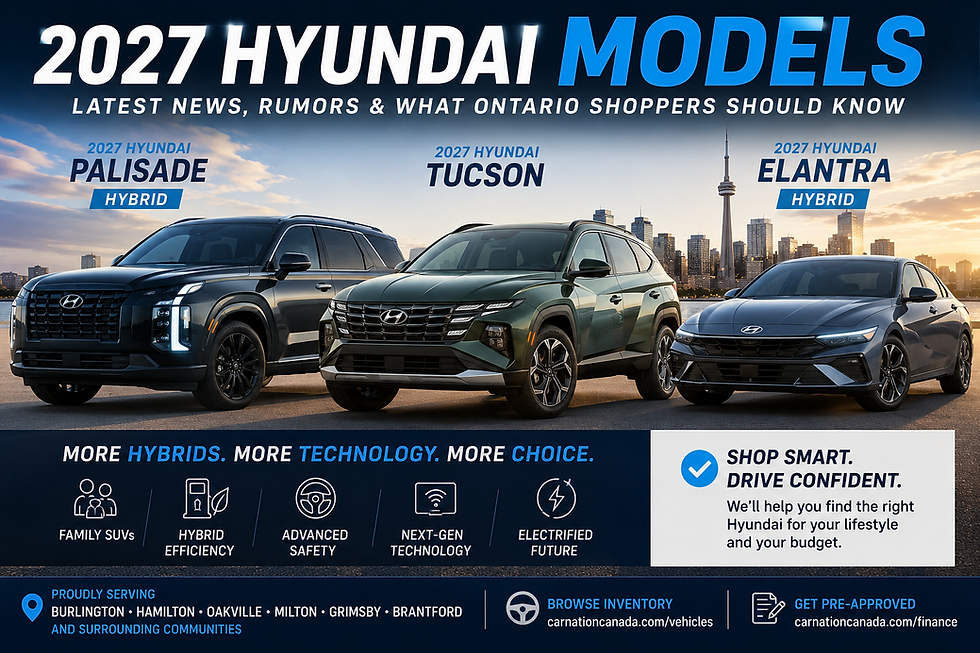
Kia Telluride / Hyundai Palisade (popular family-friendly packaging; often cross-shopped)
Nissan Pathfinder (practical 3-row layout; common in used and new comparisons)
Subaru Ascent (AWD standard; family-focused)
Volkswagen Atlas (often chosen for roomy feel)
Chevrolet Traverse / Ford Explorer (common 3-row picks; worth comparing based on cargo, power, and price positioning)
Tip from our team: don’t let “7 seats” be the deciding factor by itself—third-row comfort + cargo behind the third row is what changes day-to-day happiness.
Hybrid vs Gas vs PHEV: What Makes Sense in Southern Ontario?
Hybrids can be excellent for stop-and-go traffic, and they can reduce fuel consumption—especially if you’re doing lots of city driving. Canada’s official ratings and tools exist to help you compare trims fairly in L/100 km.
A simple way to decide:
Mostly highway kilometres? A traditional gas SUV may be “good enough,” especially if it prices out better.
A lot of city traffic / school runs / short trips? A hybrid can shine.
You can plug in consistently at home? A PHEV might be worth a look—but only if charging becomes routine.
Payment-smart note: sometimes a hybrid’s higher purchase price is worth it, sometimes it isn’t. That’s why we like to look at total monthly budget + typical km + fuel costs, not just the headline L/100 km.
Winter Driving: AWD Helps, but Tires Matter More Than Most People Think
In Ontario winters—especially if you’re moving between Burlington and Hamilton or heading toward the Niagara corridor—AWD can help you get moving in slippery conditions. But for stopping and cornering, winter tires are the bigger safety upgrade.
When you’re comparing SUVs, think of it like this:
AWD = traction to go
Winter tires = grip to stop and steer
If you’re frequently on unplowed side streets, steep driveways, or cottage roads, AWD becomes a bigger quality-of-life feature.
Towing and Road Trips: The “5,000 lb” Conversation (and What to Ask)
Many midsize 3-row SUVs fall into a towing-capable range, but towing isn’t just about a max number:
What’s the towing rating on this trim?
Do you need a towing package?
How much payload do you have left when the vehicle is full of passengers and gear?
If you regularly tow (boat, camper, utility trailer), we recommend choosing your SUV by capability first, then shopping payments second—because it’s painful to “almost” have enough capacity.
Used 7-Seater SUVs: How to Get the Most Value (Without the Regret)
If your goal is best value, used can be a strong move—especially if you want a higher trim level for the same budget.
Here’s our quick used-SUV checklist:
Service history (records matter)
Tire condition (winter/summer sets can add cost)
Brake feel + alignment (test drive at city and highway speeds)
3rd-row function (folding mechanisms, seat latches, easy access)
Electronics check (backup camera, sensors, infotainment responsiveness)
If you have a trade-in, start with a realistic plan:
Estimate trade value
Discuss whether any negative equity exists (if you owe more than it’s worth)
Build the vehicle choice around a payment you can live with comfortably
The Payment-Smart Way to Shop a 7-Seater SUV (Especially If Credit Is a Work-in-Progress)
We talk to a lot of people who are:
rebuilding after a rough year,
new to Canada (thin/no credit file),
or simply trying to keep life affordable while upgrading to a family vehicle.
Here’s the cleanest path we recommend:
Shop vehicles that fit your real needsStart with our inventory so you’re choosing from options you can actually buy.
Get a financing plan earlyUse our finance page to explore options and start the pre-approval process O.A.C. (On Approved Credit. Conditions may apply.)Pre-approval helps you:
set a realistic payment range,
avoid wasting time on vehicles that don’t fit the budget,
and make a confident decision faster.
Be honest about the “total picture”Term length, rate, trade-in position, and total cost matter. Our team will always aim to keep it transparent and judgement-free.
Conclusion
The “best” 7-seater SUV in Canada isn’t just the one with the nicest brochure—it’s the one that fits your third-row reality, your cargo life, your winter driving, and your monthly budget.
If you’re ready to narrow it down, your next step is simple:
Start by browsing: Car Nation Canada inventory
Then align it with your budget: Financing options & pre-approval (O.A.C. Conditions may apply.)
If you’re shopping from Grimsby, Brantford, or anywhere nearby, we’ll help you compare options with clear answers—no pressure, no judgement.
FAQ
1) Is a 7-seater SUV always a “true” 3-row?
Yes, but the third row can range from “kids-only” to “adult-friendly.” Always test it with your real passengers (or car seats).
2) Should I choose 7 seats or 8 seats?
If you want easier access to the third row, 7-seat (captain’s chairs) is often better. If you need three across the second row more often, 8-seat (bench) can win.
3) Are hybrids worth it in a 3-row SUV?
They can be, especially for city-heavy driving. Use Canada’s official L/100 km ratings and compare trims using NRCan tools to stay apples-to-apples.
4) What does “O.A.C.” mean in vehicle financing?
O.A.C. = On Approved Credit. Financing offers depend on lender approval and conditions may apply. It’s a compliance-safe way to describe financing availability without making guarantees.
5) Is AWD mandatory for Ontario winters?
Not mandatory, but it can help with traction. Winter tires are still the biggest upgrade for stopping and control.
--------------------------------------------------------------------------------------------------------------------------
With over four decades in the automotive industry, Dealer Principal Rick Paletta is a trusted name across the Hamilton–Burlington region. Born and raised locally, Rick is respected for his integrity, work ethic, and people-first leadership—and he still loves this business because it’s about helping neighbours, building relationships, and matching people with vehicles they’re excited to drive. His commitment to the community shows up in consistent giving, including long-running support of McMaster Children’s Hospital through Car Nation Cares.


Comments