
Bad Credit Car Loans in Burlington: How to Get Approved for Auto Financing (Without the Stress)


If you’ve been turned down for a car loan before, it can feel like you’re stuck—especially when you need a reliable vehicle to get to work, school, or appointments around Burlington, Hamilton, and the GTA West.
The good news: a “bad credit” label doesn’t mean you’re out of options. Auto lenders often look at the full picture—income, stability, affordability, and vehicle choice—not just a single score. And with the right plan, an auto loan can be a stepping stone toward stronger credit over time (O.A.C.).
At the Car Nation Canada dealerships in Burlington, we’re finance-first for a reason: we start with your budget and your real-world needs, then match you to vehicles and lending options that make sense—without judgment and without empty promises.
Key Takeaways
Bad credit car loans are often approved based on stability + affordability, not just score (O.A.C.).
The Bank of Canada policy rate influences borrowing costs across the market, so rate shopping and loan structure matter.
Focus on the total cost (not just the bi-weekly payment), and be cautious with very long terms.
When comparing offers, look at rate, term length, fees, and total amount financed—not only the payment.
Consistent on-time payments are one of the biggest drivers of credit improvement over time.

What counts as “bad credit” for a car loan in Ontario?
“Bad credit” can mean different things depending on the lender. Some lenders are stricter with credit scores, while others emphasize:
Payment history (recent missed payments vs. older issues)
Income (amount, consistency, and source)
Debt-to-income (how much you already owe vs. what you earn)
Time on the job / time at address
Down payment / trade equity
Vehicle choice (age, kilometres, loan-to-value)
So if you’re thinking, “My score isn’t great, so I’m done,” you’re often not. The better approach is: build a clean, lender-friendly application and choose a vehicle that’s easier to approve.

Why rates (and payments) feel different lately
Auto loan rates aren’t set in a vacuum. In Canada, the Bank of Canada’s target for the overnight rate is a key benchmark that influences borrowing costs across the economy.
As of December 10, 2025, the Bank of Canada’s policy interest rate (target for the overnight rate) was 2.25%. That doesn’t mean your car loan rate will be 2.25%—it means the overall cost of borrowing in the market is influenced by it, along with your credit profile, the lender, the vehicle, and the term.
Bottom line: structure matters. Two loans can have similar payments but very different total costs.

The 7 things lenders look at (and how to improve your odds)
1) Income you can prove
Lenders want to see that the payment fits your budget. Helpful documents can include:
recent pay stubs
bank statements (especially if you’re self-employed)
proof of benefits or pensions (where applicable)
Tip: If your income varies, we’ll focus on what’s consistent and supportable.
2) Job stability
Time at your current job (or within the same field) can reduce perceived risk. If you’ve recently changed jobs, don’t panic—stable income and a reasonable payment can still get approvals (O.A.C.).
3) Housing stability
Time at your address (or a steady housing situation) can help, especially for credit-rebuild approvals.
4) A payment that’s actually affordable
This is the big one. Lenders don’t just want to approve you—they want the loan to perform.

At the Car Nation Canada dealerships, we’ll talk bi-weekly comfort, not “how high can we push the payment.” If you’re commuting from Waterdown to Hamilton, or Burlington to Mississauga, reliability matters—but so does breathing room.
5) Your current debt load
If you’re carrying multiple revolving balances, your approval can hinge on keeping the car payment modest.
6) Down payment or trade-in equity
A down payment can:
lower the amount financed
help the loan-to-value fit lender guidelines
sometimes improve approval odds (O.A.C.)
Trade-ins matter too—especially if you have negative equity (owing more than it’s worth). That’s common, and it’s solvable, but it needs to be handled transparently.

7) The vehicle itself
In many credit-challenged applications, the vehicle choice makes or breaks approval. Lenders often prefer:
reasonable vehicle price vs. income
sensible kilometres for the term length
clean history
models with steady resale value
This is why we guide customers toward safe, late-model, lender-friendly options—not because you “can’t” drive something else, but because approvals become simpler and payments become smarter.

Common Burlington & Hamilton situations (and what to do next)
Consumer proposal or bankruptcy (fresh start)
If you’ve been through a proposal or bankruptcy, you’re not alone—and it doesn’t mean you can’t finance a vehicle (O.A.C.). What matters most is where you are today: income stability, budget fit, and a practical vehicle selection.
A finance-first approach here is all about rebuilding without overextending.
Newcomer to Canada / thin credit file
Newcomers often have strong income but limited Canadian credit history. In these cases, lenders may look more at:
job letter / pay history
down payment
residence stability
We’ll help you build an application that makes sense for your situation.
Self-employed income
Self-employed buyers often get stuck because paperwork feels complicated. The solution isn’t “give up”—it’s organising the right documents (bank statements, NOA where available, invoices/contracts) and choosing a loan structure that fits.
Fallen-prime family: “we just need a reliable vehicle and a stable payment”
If your credit took a hit due to life events—job change, family costs, unexpected bills—the strategy is often:
pick a dependable vehicle with reasonable km
keep term length sensible
avoid stretching the payment to the edge
plan for credit improvement over time

Don’t shop by payment only: focus on total cost (and long-term risk)
The Financial Consumer Agency of Canada recommends looking at the total cost, not just the payment or interest rate, and understanding the risks of long-term car loans.
Here’s why: a longer term can lower the payment, but it typically increases total interest paid—and can raise the chance you owe more than the vehicle is worth for longer (negative equity).
A better goal: a payment you can comfortably afford and a term that doesn’t trap you.
Will applying for financing hurt my credit?
Applying can create a credit inquiry, but there are smart ways to manage this.
The Government of Canada notes that when you’re shopping around for a car loan, it can help to keep your quote comparisons within a short window—credit bureaus may treat inquiries in a limited period as a single inquiry for scoring purposes.
Practical tip:
Do your shopping intentionally (don’t apply everywhere for weeks)
Use a dealership that can guide you through options efficiently
Ask questions before you sign anything
Also important: FCAC notes there’s generally no cooling-off period for car loans and lease agreements in most provinces/territories—so you want to be confident before signing.

The Car Nation Canada dealerships' approach: finance-first, not pressure-first
Here’s what our process typically looks like for bad credit car loans in Burlington:
Step 1: Quick budget check (real numbers)
We’ll talk:
income and pay schedule
existing obligations
insurance expectations
what payment feels comfortable
Step 2: Build a clean application package
We’ll help you prepare what lenders usually want to see—so you’re not guessing or scrambling.
Step 3: Match you to lender-friendly vehicles
This is where approvals often improve: aligning the vehicle with lender guidelines and your life (commute, family, winter driving, cargo needs).
Step 4: Review offers clearly
We’ll walk through:
rate and term
payment schedule
total amount financed
any fees that apply
No “mystery math.” You should understand what you’re signing.
Financing options are available for many credit situations (O.A.C.). Conditions may apply.

How a car loan can help rebuild credit (if you do it right)
A car loan can support credit rebuilding because it’s a form of installment credit and creates a payment track record.
The Government of Canada emphasizes that payment history is the most important factor in your credit score—and improving it starts with making payments on time and contacting lenders early if you’re at risk of missing a payment.
A safe, realistic credit-rebuild plan usually includes:
a payment you can comfortably make in every season (not just in a good month)
automatic payments where possible
avoiding over-application for credit
keeping other revolving debt under control
Conclusion: reliable wheels + a payment that makes sense
Bad credit car loans don’t have to feel like a dead end—or a gamble. When you focus on the full picture (income, stability, vehicle choice, and total cost), approvals become more realistic and less stressful (O.A.C.). And with consistent on-time payments, you give yourself the best chance to move forward financially over time.
If you’re in Burlington, Hamilton, Stoney Creek, Waterdown, Oakville, or Milton, the Car Nation Canada dealerships are here to help you map out a straightforward next step.
Ready to start?
Apply for financing online (O.A.C.)
Get a transparent trade-in appraisal
Book a test drive, and let’s build a payment plan you can live with

FAQ: Bad Credit Auto Financing in Burlington
Can I get a car loan with a consumer proposal or bankruptcy?
Often, yes—depending on your current income stability, budget fit, and lender guidelines (O.A.C.). The key is building a realistic structure and choosing a vehicle that aligns with approval criteria.
What credit score do I need for a bad credit car loan?
There’s no single number. Some lenders focus heavily on score; others weigh income, stability, and affordability more. Your “approval path” depends on your overall profile (O.A.C.).
How much down payment do I need?
It varies. Some approvals work with minimal down payment; others may require more to fit lender loan-to-value guidelines (O.A.C.). If you have a trade-in, your equity position matters too.
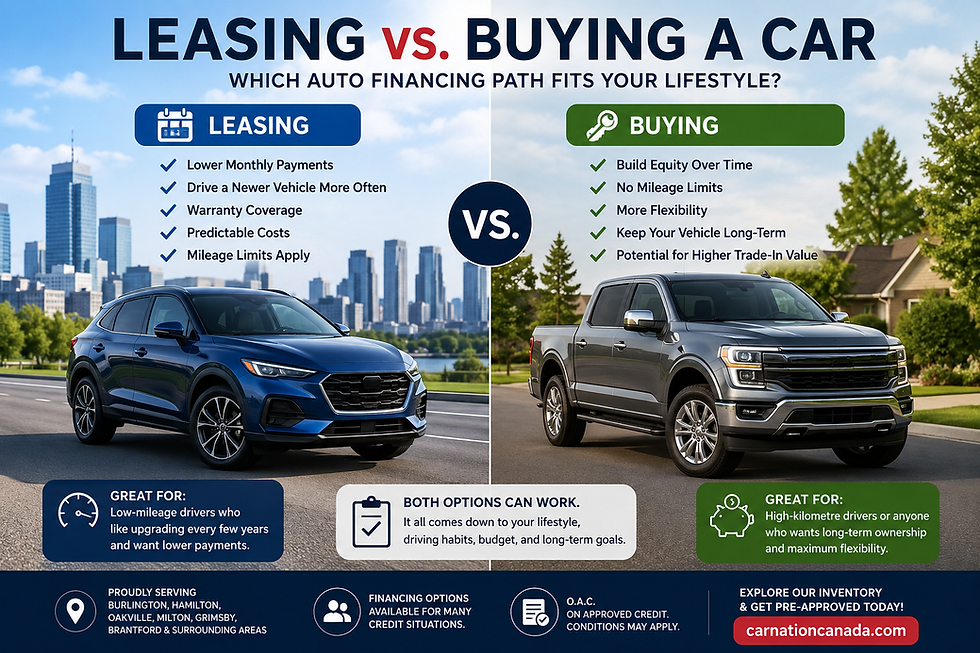
Should I choose a longer term to lower my payment?
A longer term can lower the payment, but it can increase total interest and raise the risk of negative equity. FCAC recommends looking at the total cost and understanding the risks of long-term loans.
How can I improve my credit while financing a car?
Start with the basics: make every payment on time and manage other debts carefully. Payment history is a major factor in credit scores.
With over four decades in the automotive industry, Dealer Principal Rick Paletta is a trusted name across the Hamilton–Burlington region. Born and raised locally, Rick is respected for his integrity, work ethic, and people-first leadership—and he still loves this business because it’s about helping neighbours, building relationships, and matching people with vehicles they’re excited to drive. His commitment to the community shows up in consistent giving, including long-running support of McMaster Children’s Hospital through Car Nation Cares


Comments